The Center for Human-AI Innovation in Society

CAHMP HCI Group Meeting – December 8, 2022


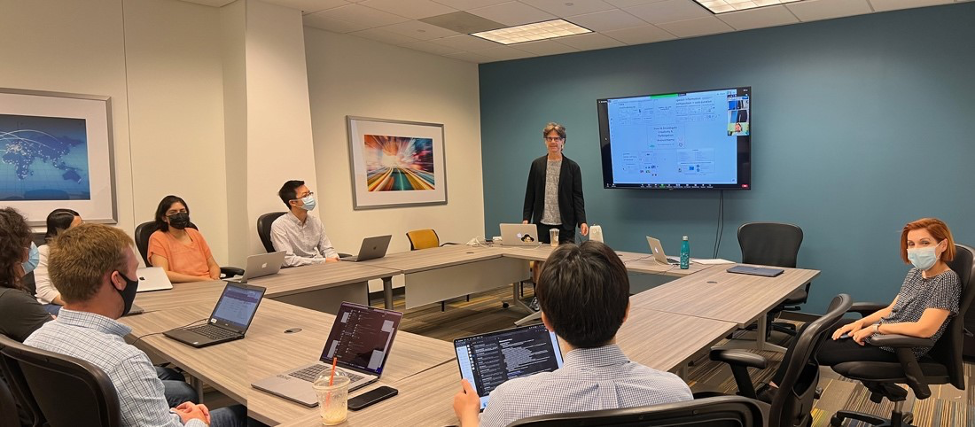
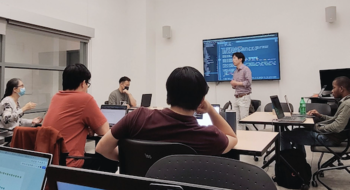
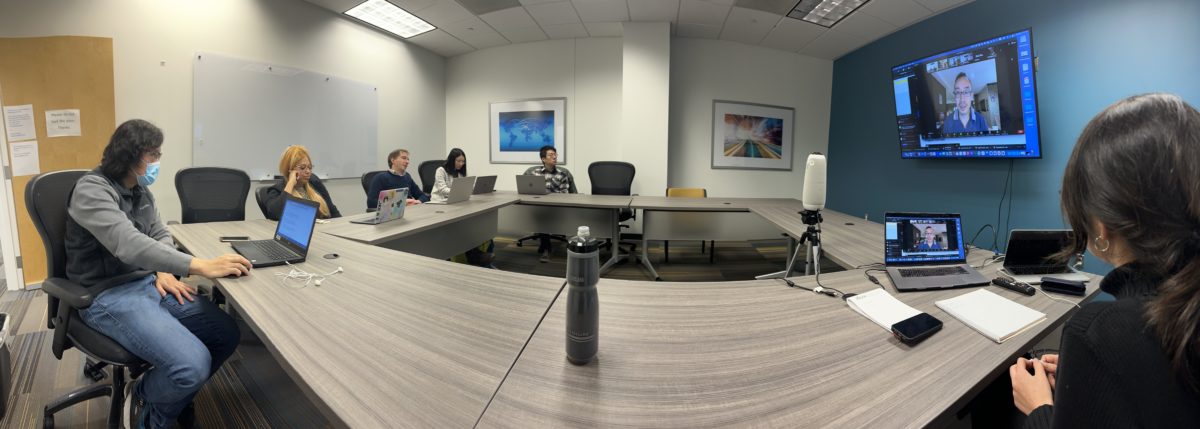
The Center for Advancing Human-Machine Partnerships (CAHMP) held a HCI group meeting on December 8th, 22. About a dozen participants from CEC and CHSS joined this hybrid (on-line and in-person) meeting. This event was a follow-up on the June HCI workshop, which signaled the beginning of a new stage in interdisciplinary research and community building around HCI at Mason.  The HCI group is one of several community-building initiatives at CAHMP to foster faculty collaborations and meaningful outreaches with industry partners.

At this meeting, two Army Research Laboratory (ARL) HCI researchers, Dr. Alfred Yu and Dr. Katherine Cox, joined the group online and debriefed on ARL’s recent HCI related initiatives, including the Cross-Mission Team Evolution (CMTE) Research Thrust within the ARL Human Autonomy Teaming Essential Research Program (HAT ERP) which is developing capabilities to improve Soldier-system team performance in missions through adaptation and learning via after-action review and mission planning. Many other ARL research focuses, including the development of wearables for real-world assessment of warfighter performance, data mining of large behavioral datasets to understand real-world visual search, augmented perception in extended reality, and computational modeling of the biophysical mechanisms of neurostimulation, find overlaps with the current research and work by CAHMP faculty members.

The meeting wrapped up with a plan to continue engage ARL for future collaborations. Participants also exchanged some insightful thoughts on upcoming HCI funding opportunities.

 

Global City Teams Challenge

Global City Teams Challenge: Strategic Planning Workshop Working Group Series

Project Investigators

CAHMP Co-directors, Brenda Bannan (Principal Investigator) & Dave Lattanzi (Co-Principal Investigator) (2022) lead Global City Teams Challenge Strategic Planning Workshop Working Group Series, sponsored by National Institute for Standards and Technology (NIST). The CAHMP team submitted the proposal in March, 2022 and was awarded $89,390 over one year.

In 2022, the National Institute of Standards and Technology (NIST) awarded funding to George Mason University (GMU) to conduct a two-part workshop series to develop an integrated and supportive community-centric strategy to inform, strengthen and expand the Global Community Technology Consortium (formerly the Global City Teams Challenge) (GCTC) program, in an effort to facilitate and enhance smart and connected communities technology research, development and application.

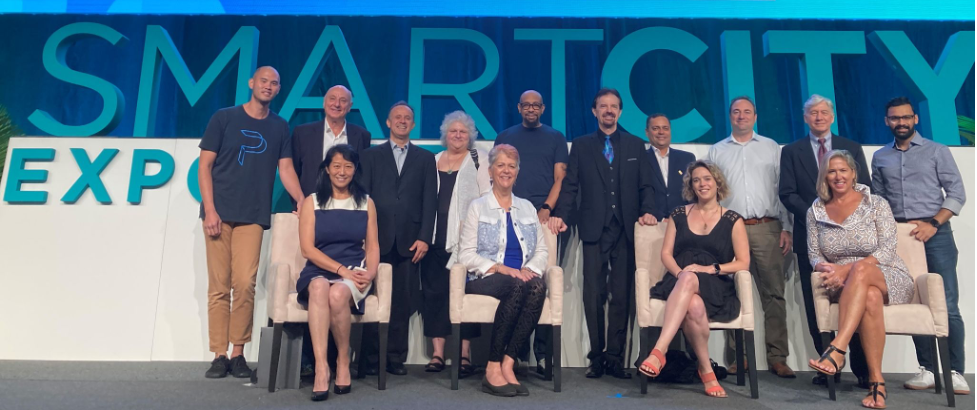
In early August of 2022, the GCTC leadership convened in Arlington, Virginia, at Mason Square on GMU’s Arlington campus as the first workshop meeting in a two-part series. This first workshop, sponsored by the Center for Advancing Human-Machine Partnerships (CAHMP) at GMU and organized by Dr. Brenda Bannan, was designed to establish a strategic research vision for the GCTC. The workshop provided the leadership of the twelve SuperClusters, also known as Technology Sectors, an opportunity to better understand how the GCTC interacts with internal and external partners to achieve technology deployment and implementation for the purpose of informing the strategic vision. This workshop was followed by a mid-September workshop sponsored by the City of Coral Gables, Florida, and held in their Public Safety Headquarters Smart Building. Augmenting the findings of the first workshop, the second workshop held was designed to delineate the specific priorities and activities of the strategic plan. The leadership of this organization, including Dr. Bannan, attended the SmartCity Expo USA in Miami, Florida as part of the event.

Synthesized results from this workshop series: 1) inform and guide the strategic directions of the NIST GCTC organization to benefit communities and the public related to advanced cyber-physical technologies; and 2) yield insights into the complex and interdependent challenges of disseminating and implementing technology in the smart and connected communities vision.

Interactive Augmented Reality


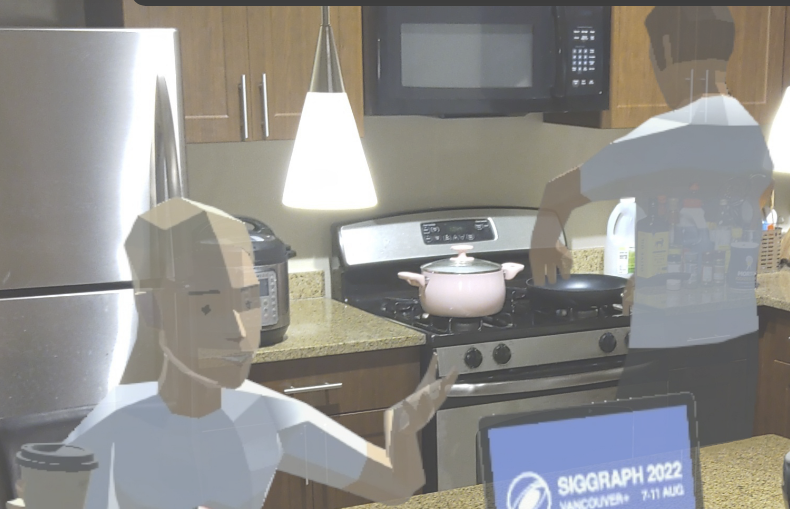
Recently, CAHMP faculty, Dr. Craig Yu, is involved in a group researchers that present a novel interactive augmented reality (AR) storytelling approach guided by indoor scene semantics.

Their approach automatically populates virtual contents in real-world environments to deliver AR stories, which match both the story plots and scene semantics. During the storytelling process, a player can participate as a character in the story. Meanwhile, the behaviors of the virtual characters and the placement of the virtual items adapt to the player’s actions. An input raw story is represented as a sequence of events, which contain high-level descriptions of the characters’ states, and is converted into a graph representation with automatically supplemented low-level spatial details.

Their hierarchical story sampling approach samples realistic character behaviors that fit the story contexts through optimizations; and an animator, which estimates and prioritizes the player’s actions, animates the virtual characters to tell the story in AR. Through experiments and a user study, they validated the effectiveness of the approach for AR storytelling in different environments.

For more information about this project, please click here.

Also see Craig’s work in assistive robotics here.

CAHMP Mini Symposium – “Connecting Technology and Humans”, October 5, 2022


CAHMP hosted a mini symposium on Wednesday Oct. 5, featuring three speakers and a panel on topics connecting technology and humans. CAHMP’s co-director, Sanmay Das, served as the moderator. More than 50 faculty and students participated in this event either in person or virtually. This event is among many of CAHMP’s organized efforts in catalyzing the engagements and collaborations among researchers from across the campus and disciplines.

Three speakers and their topics are:

Dr. Ray Hong, Assistant Professor of Information Sciences and Technology at George Mason University. Topic: Alignable AIs: Bridging the gap between the Ways Human Thinks and Deep Neural Model Works through Interactive Design

Dr. Gregory Stein, Assistant Professor of Computer Science at George Mason University. Topic: Explainable Interventions: Understanding and Correcting Robots that Plan Despite Missing Knowledge

Dr. Sera Linardi, Associate Professor of Economics at the Graduate School of Public and International Affairs and Founding Director of the Center for Analytical Approaches to Social Innovation at the University of Pittsburgh. Topic: Building a data science for social justice ecosystem to sustain impact

To become a speaker at future CAHMP symposiums, please contact CAHMP assistant director, Peng Warweg – [email protected].

CAHMP HCI Workshop, June 21-22, 2022

Mason HCI Community Building 

The Center for Advancing Human-Machine Partnerships (CAHMP) and the Institute of Digital InnovAtion (IDIA) co-organized on June 21-22 a two-day Human Computer Interaction (HCI workshop. The workshop signaled the beginning of a new stage in interdisciplinary research and community building around HCI at Mason.  


This hybrid event brought together thirteen Mason’s Human-Computer Interaction (HCI) researchers across the School of Computing, the School of Art, and the College of Humanities and Social Sciences. Workshop participants built community, identified gaps and opportunities in the national HCI research landscape, outlined core research expertise and capabilities in the Mason HCI community in direct alignment with national priorities, and formulated synergistic research development activities. 


The second day featured a visit by Dr. Andruid Kerne, current NSF Program Director in the Directorate for Computer Information Science and Engineering, and provided the workshop participants with the opportunity to engage directly with an NSF Program Director on relevant HCI-related opportunities across the Foundation.  


This workshop marks the beginning of a new day for HCI research at Mason, as well as the beginning of direct, guided collaborations between IDIA and the Transdisciplinary Centers. 


Mason Participants:  

Sanmay Das, Professor of Computer Science, SoC; Co-director, CAHMP 

Craig Yu, Associate Professor of Computer Science, SoC 

Myeong Lee, Assistant Professor of Information Sciences, CEC

Brittany Johnson, Assistant Professor of Computer Science, SoC 

Kevin Moran, Assistant Professor of Computer Science, SoC 

Gerald Matthews, Professor of Psychology, CHSS 

Shanshan Cui, Associate Professor, School of Art 

Ziyu Yao, Assistant Professor of Computer Science, SoC 

Zhisheng Yan, Assistant Professor of IST, SoC 

Yotam Gingold, Associate Professor of Computer Science, SoC 

Vivian Motti, Assistant Professor of IST, SoC 

Vania Neris, Associate Professor – Department of Computing – Federal University of São Carlos – Brazil; Visiting Scholar – Department of Information Sciences and Technology – George Mason University 

Peng Warweg, Assistant Director, CAHMP 

Amarda Shehu, Professor of Computer Science, SoC; AVP of Research, IDIA 

Greg Stein

CAHMP Names New Center Co-director

CAHMP’s co-founder/director, Amarda Shehu has been named Mason’s Associate VP of Research for IDIA starting May 25, 2022. In her new role, Amarda will help to shape Mason’s institutional landscape of computing and digital society, while continuing to promote Mason’s research and innovation. Amarda is one of the three founding leaders of CAHMP. Together with Brenda Bannan and Dave Lattanzi, the three co-directors envisioned, brought a team of faculty around that vision, and ultimately were successful in obtaining funding for CAHMP as a Provost Transdisciplinary Center in 2019. CAHMP would not have existed without their visionary proposal in 2019. Under their leadership and CAHMP’s amazing faculty community, we have achieved many feats together, including the submission of the mega proposal of AI Institute, which, in turn, led to a slew of proposals and awards. In addition to our research capacity, CAHMP is also gaining traction on other critical initiatives at Mason, including curriculum development and entrepreneurship. 

With Amarda stepping out, we are fortunate and glad to announce that Sanmay Das, Professor of Computer Science, has very graciously accepted to step into Amarda’s role as CAHMP’s new co-director.

As a CS professor, Sanmay has broad interests across AI, machine learning, and computational social science. His research interests are in designing effective algorithms for agents in complex, uncertain environments, and in understanding the social or collective outcomes of individual behavior. Of late, he has been particularly interested in understanding the societal implications of the use of algorithms in allocating scarce societal resources. In the broader AI community outside Mason, Sanmay serves in several roles, including as the chair of the ACM Special Interest Group on Artificial Intelligence and as a member of the board of directors of the International Foundation for Autonomous Agents and Multiagent Systems. Sanmay served as one of the Co-PIs on CAHMP’s AI Institute proposal in 2020 soon after he joined Mason. Since then, he has taken on various leadership roles here at Mason. Sanmay has been instrumental to CAHMP’s mission at advancing human-machine partnership in research, education and technology transfer, and will now continue with that commitment in a new leadership role as a CAHMP co-director. His interdisciplinary research embodies what is best about CAHMP. 

Digital Archive – Joint Project between Art and Information Science

CAHMP’s Shanshan Cui (Associate Professor, School of Art) and Myeong Lee (Assistant Professor, Information Science) led a Summer Team Impact Grant project on building a digital archive on the Chinese Anti-Rightist Campaign in the 1950s. This interdisciplinary project has not only brought a rich and innovative research experience to Mason students, but also is expected to impact the field of history and humanities education. Please check out their story on the George below, or here.

Gerald Matthews

2022 CAHMP Entrepreneurship Challenge Opening Ceremony

CAHMP MIX Flyer 12-21-21 for email
Application before January 31, 2022 is highly encouraged. Late applications may be accepted on a case-by-case basis. Click here to sign up.


Activities include workshops, seminars and final business idea competition. The program runs from February to May 2022. 

Undergraduate and graduate (Master’s and Ph.D.) students are all encouraged. Students can sign up individually, or as a team. If you’d like to be paired with a partner or team, please let us know. 


Contact: Peng Warweg  [email protected]